
When enterprises evaluate and deploy AI automation tools, many teams encounter the same difficulty: the more detailed an AI skill package becomes, the more tokens a conversation consumes, driving up computing costs and response latency.
Putting two or more sets of professional skills, rules and templates into a single prompt or static file wastes the context window on every interaction. Breaking large skill packages into a workflow, or agentic multi-step pattern, can save enterprises as much as 80–90% in token consumption.
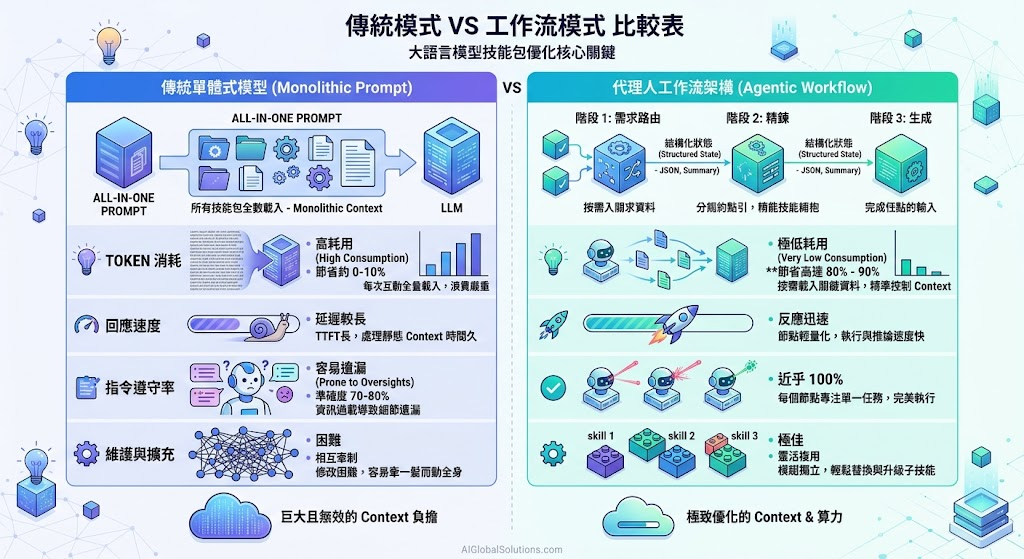
1. The hidden threats of large skill packages: wasted tokens and declining performance
Skill designers often take a monolithic approach, combining background knowledge, review criteria, exception handling and output formats in one package. This creates three bottlenecks:
- High fixed costs: Even when the user asks a small question, the system must read the entire large skill description again for every response.
- Context noise: Excess information disperses the model's attention, causing it to miss details or fail to follow particular rules.
- Accumulating irrelevant information: During a long conversation, verbose intermediate results from earlier steps remain in context, consuming computing resources and tokens unnecessarily.
2. How can a workflow architecture save 80–90% of tokens?
The core idea is to divide a complex task chain into independent nodes, each with a single responsibility, coordinated through state management.
1. Lazy loading and dynamic routing
A workflow begins with a very small router. When a user submits a request, the router calls only the smallest skill module needed by the current node, instead of loading all available material into memory at once.
2. Stateful handoff replaces retaining complete transcripts
A traditional conversation carries the complete message history into the next computation. At a workflow transition, only structured key state, such as JSON data or a concise summary, passes to the next step. Filtering out more than 90% of unnecessary conversational details substantially reduces the size of the context window.
3. Modular design and component reuse
A large skill package can be split into independent components for data extraction, logical analysis and format generation. Specialized components run only when specific conditions trigger them, directing computing resources to the work that needs them.
3. Traditional approach versus workflow approach
| Evaluation criterion | Monolithic prompt | Workflow architecture |
|---|---|---|
| Token consumption | Loads the entire context on each interaction, consuming large numbers of tokens | Loads dynamically by step, saving 80–90% of tokens |
| Response speed | Large inputs increase time to first token (TTFT) | Lightweight nodes significantly improve response and execution speed |
| Instruction following | Information overload can cause the model to miss critical rules | Each node focuses on a single task, with accuracy approaching 100% |
| Maintenance and expansion | Changing one rule can affect the entire conversation | Independent modules make individual steps easier to adjust and extend |
Conclusion: from prompt engineering to agentic workflows
As AI applications mature, rigorous cost control and system stability are two key requirements for enterprise adoption at scale.
Moving away from packing all knowledge into a giant prompt and adopting modular workflows can deliver a several-fold cost advantage while creating AI systems that respond faster and reason more consistently.